artikel | 29 augustus 2026
The fall of Kabul (1)
The Fall of Kabul (1)
Anyone who struggles with vertigo would do well not to stare too long into the chasm that yawns between the Ministries of Defence (MOD) and Foreign Affairs (MFA). The depth is dizzying, caused by the distinction between the two: whispers, necessary to keep the dialogue going, versus loud commands to remain understood; silent limousines contrasted with rattling caterpillar tracks; beating around the bush versus heading straight for the target. This is why a ‘pas de deux’ rarely leads to fluid dance steps and often culminates in a clumsy stumble. This was also the case in Afghanistan, where MFA and MOD co-ordinated the so-called reconstruction mission in Uruzgan together for years.
In August 2021, fate condemns them to each other once again during the fall of Kabul and the apocalyptic retreat of Western powers. In their wake, thousands of Afghans attempt to escape via the airport. They cling to the wings and wheels of departing aircraft. Desperate attempts that end on the tarmac of the runway or, moments later, on the snow-capped peaks of the Hindu Kush mountains.
The chaos at Hamid Karzai International Airport is directly proportional to that in The Hague, with disastrous consequences for Dutch citizens of Afghan descent trapped in Kabul and local staff who interpreted for the Ministry of Defence or worked at the Dutch embassy. Outside the airport gates, they brave mortal terror, humiliation and violence. Because the Dutch government falls short, they stand for hours, sometimes days, in an open sewer while bullets fly around them.
In political The Hague, the sense of urgency penetrates only with great difficulty, with the exception of a section of the Dutch Parliament. Responsible ministers are preoccupied with a ritual dance around the longest cabinet formation in our parliamentary history. A vacuum of indecision emerges with dramatic consequences.
This story reconstructs the retreat from Kabul using eyewitness accounts, government documents, WhatsApp and Twitter messages, and smartphone videos. The Hague and Kabul are separated by a 2.5-hour time difference. The time indications in this narrative, which begins and ends with a bomb attack, always refer to local time.
‘They are already in the city’
Tuesday, 3 August 2021, 19:54, Kabul, Afghanistan, Dutch Embassy
The blast echoes, reverberating off the buildings. The Dutch embassy staff are relaxing in the courtyard after their weekly barbecue, having coincidentally just discussed what to do in such a situation. The sound of breaking glass precedes the incoming shockwave. “Go! Go!,” screams deputy ambassador Cees Roels unnecessarily, springing to his feet. As glasses, cups, and empty bottles fall and they feel the hot air rushing through, everyone rushes to the bunker, the secure room. “What the hell!” someone calls out while running. Once inside, the steel door is locked. Then it becomes nearly quiet; human panting mixes with the humming of a computer and the air conditioning, which is working hard.
The sun went down an hour ago; outside in the abandoned courtyard, the thermometer reads thirty degrees. “That was near!” a staff member breaks the silence. His statement is met with deep sighs and agreeing murmurs.
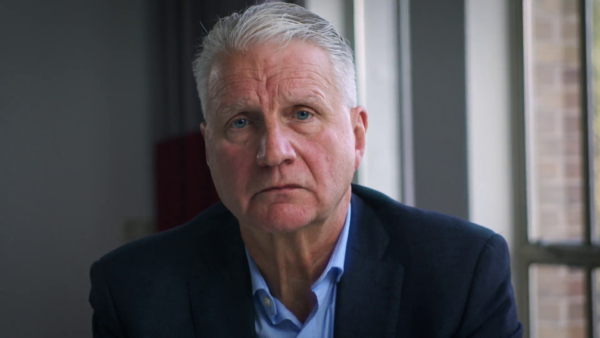
Deputy ambassador Cees Roels. Photo: still from Zembla 7 April 2022 (camera: Ton Vanderplas)
19:55 The Afghan entrepreneur Ajmal Hasas posts images on Twitter of meters-high flames marking the site of the explosion. ‘Allahu Akbar,’ men shout off-camera.
20:15 The embassy bunker has been set up and is ready for an extended stay. Roels asks the local staff to remain there until further notice. He himself goes with two staff members to the ‘control room’ elsewhere in the building. Close protection officers from the BSB (Brigade Special Security Tasks) are scouring social media and local news channels there, analysing reports from other embassies. Computer screens display footage from security cameras around the compound and from elsewhere in the city. Twitter posts from residents in the centre are numerous and complete the picture.
20:55 Businessman Hasas records from his flat how loud cries of approval can still be heard. His tweet confirms the impression that the situation is not yet under control.
21:47 Cees Roels emails the Ministry of Foreign Affairs in The Hague: ‘This explosion, caused by a car bomb, was followed by a complex attack that is ongoing to date (21:30). (…) Dutch embassy staff have gathered in the bunker and the Crisis Coordinator on duty has been informed. No further details at this time.’
The car bomb detonated on Sher Ali Khan Road, one and a half kilometres away, on the edge of the heavily fortified Green Zone: the district housing the NATO headquarters, most embassies, and also restaurants and hotels for expats. Roels has been our man in Kabul since late July 2020 and serves as the deputy to Ambassador Caecilia Wijgers. They alternate every six weeks. This is the final assignment before his retirement. “Sitting at home is not for you, so just go ahead and do it,” his wife had said when he was asked. He knew she was right. On 1 September, his diplomatic career will come to an end. He plans to celebrate his farewell here a few days prior. That party will probably not happen, he reflects. The Taliban are advancing further and further, and tonight they have shown they are capable of penetrating right into the city centre. ‘They are already in the city,’ Roels emails his wife. He knows this is the final act of the doomsday scenario, the first lines of which were already written over eighteen months ago.
‘We leave no one behind’
Saturday 29 February 2020 Doha, Qatar
It is the final year of his first term. President Donald Trump assesses that a peace agreement and an American withdrawal will boost his chances of re-election. In the partly secret agreement, the Taliban pledge to enter into negotiations with the incumbent Afghan President Ghani. The latter has not agreed to this; he was not even invited to the peace talks. This raises the question of what the agreements are actually worth. But dealmaker Trump has no doubts. Following the signing of the Agreement for Bringing Peace to Afghanistan, he shows his satisfaction: the Americans are tired of a war without results. His troops will leave Afghanistan by 1 May 2021. However, that autumn he loses the election. A few weeks before the planned exodus, his successor announces that this deadline is unachievable.
Wednesday 14 April 2021 Washington, United States
President Joe Biden, a fierce opponent of the mission from the very beginning, sets a historically fraught date for the final withdrawal: 11 September. In a speech, he emphasises that the goals following the 9/11 attacks have been achieved. Bin Laden is dead, Al-Qaeda degraded. Nation-building, he claims, was never the goal.
Laag-Keppel, The Netherlands
The blood of former General Mart de Kruif begins to boil. There is no truth to the presidential rhetoric. As ISAF commander in southern Afghanistan, De Kruif led 45,000 troops. The international NATO mission was precisely meant to build up local institutions, so that the police and army could guarantee stability and prevent the return of the Taliban. The mission had been set up because the Americans, as the first country in history after 9/11, invoked Article 5 of the NATO treaty: an attack on one is an attack on all.
Under De Kruif’s command, 282 soldiers lost their lives. It was his task to inform the families. He visited many of them personally, even years later, to emphasise that their sons and daughters had not fallen in vain, but for the safety of the West. Biden is now calling the value of that ultimate sacrifice into question. The president should be ashamed of himself, De Kruif believes.
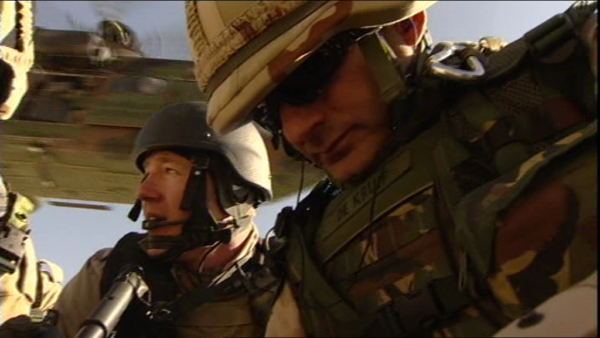 General Mart de Kruif in Uruzgan. Photo: still from Reporter september 2009 (camera Ton Vanderplas)
“This is the end of ‘America’s longest war’,” Biden speeches: “it’s time for American troops to come home.” Cees Roels, the Dutch deputy ambassador in Kabul, still remembers what he thought when he heard the announcement: this is the starting gun for the final Taliban offensive.
Brussels, Belgium
NATO announces its military withdrawal following the lead of the US. The alliance will only remain active on diplomatic and economic levels.
Friday 16 April 2021 The Hague, The Netherlands, Binnenhof
The Council of Ministers decides to send eighty additional troops to Kunduz in Northern Afghanistan to support the logistical retreat and informs the Dutch Parliament.
Thursday 24 June 2021 Kunduz, Afghanistan
The Ministry of Defence withdraws its final troops. With this, a major pillar of the Dutch 3D strategy—defence, diplomacy and development—collapses. It marks the end of twenty years of Dutch military presence. This may seem like a long time, but in the eyes of veterans, the reconstruction is far from complete. ‘We are abandoning them,’ one of them WhatsApps me.
A month earlier, a group of soldiers had already sounded the alarm with a full-page advertisement. The core message is that Afghan interpreters who worked for the Netherlands and risked their lives are now in acute danger due to the advancing Taliban. Countries like the United Kingdom, Germany, France and Australia are already evacuating their local staff on a large scale. The veterans believe this is a moral duty. The Hague must push aside the bureaucracy and bring back the interpreters and their families. Otherwise, they note, we will fail to live up to our motto: ‘We leave no one behind.’
Thursday 8 July 2021, 14:00 The Hague
Two weeks later, it emerges in the House that Minister of Defence Ank Bijleveld has taken no action. This is despite the fact that, as early as 3 June, she embraced a motion stating that the interpreters had to be evacuated before the troops returned. She had misunderstood Parliament’s appeal, she defends herself that afternoon. She thought it only concerned interpreters who were already in a formal asylum procedure.
Brand-new MP Derk Boswijk (CDA), himself an army reserve officer and in close contact with veterans, voices the deep moral frustration over the lack of decisiveness. The situation hits him hard, both personally and politically.
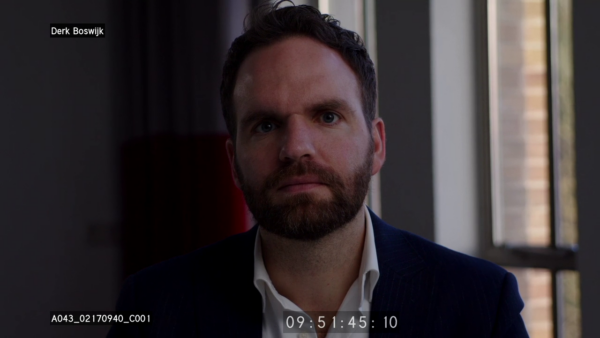 MP Derk Boswijk. Photo: still from tv interview 2022 (camera: Ton Vanderplas)
As far as Boswijk is concerned, they need to ‘colour outside the lines’ as quickly as possible. Bijleveld promises to rectify her mistake, but she rules out a Non-combatant Evacuation Operation (NEO)—a military civilian evacuation. The Ministry of Defence will, at most, make aircraft available. However, an Afghanistan veteran has been asked to assess the interpreters’ requests, and a consular officer has been added to the embassy staff. The latter, incidentally, never arrived in Kabul.
‘No sense of urgency and responsibility’
Wednesday 4 August 2021, 08:30 Kabul, Dutch Embassy
Cees Roels has worked in crisis zones before. Like his local staff, he is used to a lot, but this morning he sees how deeply the previous night’s attack has hit home. The target was the Afghan Minister of Defence. He survived the car bomb at his heavily secured residence, but during the hours-long gunfight with Taliban fighters who had penetrated the district, three civilians were killed and seven wounded. This is the signal, his Afghan staff members tell Roels emotionally. Now things will move fast.
The diplomat thinks about the evacuation scenarios. They do not leave him optimistic. If the situation becomes acute, he will never manage with his BSB team to get the embassy staff, dozens of Dutch citizens, and hundreds of interpreters and their families out of the country. He urgently needs extra logistical capacity for visas, plus force protection: troops to safely escort evacuees to the airport.
Kabul, Shahr-e-Naw district, 11:30
Medical student Musafir Nader from Rotterdam flew to his country of birth last Thursday. He ignored the negative travel advice; his father is on a ventilator with a severe COVID infection. This was presumably the last chance to see him alive. He is glad he made it, but his return ticket is booked for 15 August. Ever since this morning, he has been trying in vain to bring his return flight forward.
Kabul, Dutch Embassy, 17:36
In an email to Foreign Affairs, Roels outlines the urgency: ‘Simply flying in a plane is insufficient. Action: prepare a team to receive those interpreters who are already in Kabul, check their IDs and escort them for evacuation (military).’ A response from The Hague is not forthcoming.
The Hague, Ministry of Foreign Affairs, 15:06
Behind the scenes, civil servants realise all too well that things are going wrong. According to them, the fact that no action is being taken is due to their colleagues at the Ministry of Defence. There, as one of them writes, ‘no sense of urgency and responsibility’ prevails.
The blame game has begun. The credo is: prevent political damage and protect one’s own minister. This certainly applies during a crisis for which accountability must be rendered in the House. ‘Apparently, DEF is of the opinion that the above does not lie with them, but then it is good to know why we believe that it does,’ the official continues. His colleague responds in agreement: ‘These combined reactions expose that the department bearing primary responsibility contributes the least to the solution.’ However, the duo takes no action to break the deadlock. But Foreign Affairs does tighten the travel advice the following morning. Consultation with the embassy in Kabul does not take place.
Thursday 5 August 2021, 08:00
‘DO NOT travel to Afghanistan. The Dutch embassy in Kabul urges Dutch nationals to leave Afghanistan as soon as possible. (…) The Dutch embassy cannot support or evacuate Dutch nationals, especially now that extreme emergencies are occurring.’
Kabul, Macroyan district, 11:00
Wahid reads the message. He works in the catering industry and has lived in the Netherlands for twenty years. At the time, he fled from the Taliban; now he has underestimated the situation. When he left the Netherlands, the Taliban were fighting in far-off provinces. Now he is in Kabul to sort out the travel documents of his wife and five children, who have recently obtained Dutch passports, so they can travel to the Netherlands together. They have not seen each other for nearly two years.
‘Everything inside you screams to go back’
Friday 6 August 2021 Kabul, centre
The Taliban carry out another targeted attack. The head of the Government Media and Information Centre is shot dead on his way to Friday prayers. In the south, the first provincial capital falls: Zaranj.
The Hague, Frederikkazerne
The Military Intelligence and Security Service (MIVD) describes in its reports the inability of Afghan troops to stop the Taliban. However, the appetite for intelligence from within the ministry is declining. The MIVD reduces its efforts, but does report a day later that Sheberghan in the north has also fallen. Strategically important because of its natural gas fields.
Sunday 8 August 2021 The Hague
It is tempestuous in the Netherlands; strong winds and heavy downpours. Politicians are wrestling with declining public trust and the cabinet formation talks are completely deadlocked. The eight o’clock news opens with the closing ceremony of the Tokyo Olympic Games, which were highly successful for our country. While the flame is ceremonially extinguished in Japan, extreme wildfires in the country where it was lit a month earlier, lay the island of Evia to ashes. Behind residents and tourists fleeing onto the water in small boats, the approaching disaster turns the horizon orange. In the Netherlands, new coronavirus measures further fuel the fire of social unrest.
In the evening news bulletins, the NOS and RTL cover the fall of Kunduz, the city where Dutch troops were still providing training for local law enforcers just a month and a half ago. Amateur footage shows street fighting, burning shops, and government buildings where the Taliban flag is already flying. The fact that the superior numbers of government troops are overwhelmed so quickly proves the Dutch veterans right: the Afghan army cannot stand on its own two feet.
The veterans express their solidarity with the population. “Everything inside you screams to go back and try again,” one of them says in front of a television camera. The offensive is moving at a breakneck pace. Tens of thousands of civilians are fleeing towards the capital. However, departure is not an option for deputy ambassador Roels and his team; they must manage to get hundreds of people out of the country. To do so, they need support. But it is nowhere in sight. When it comes to the Dutch deployment in Afghanistan, a shortage of personnel has, in fact, been a constant from the very beginning.
Thursday, 27 October 2005 The Hague, Ministry of Defence.
The Netherlands has been supporting its NATO partner, the United States, with small-scale military operations since 2001, but pressure on The Hague to provide a more robust contribution is growing. In his office, Commander of the Armed Forces Dick Berlijn finalizes his military advice to Minister Henk Kamp (VVD) regarding the deployment for the NATO mission ISAF in Southern Afghanistan. The Netherlands is to become the leading nation in Uruzgan, a province two-thirds the size of the Netherlands with 300,000 residents, of whom 80% are illiterate, with no television, radio, or newspapers. Only 4% of boys go to school, and less than half a percent of girls. The conservative tribal elders pay no heed to the central authority in Kabul, and the Taliban has a firm power base there.
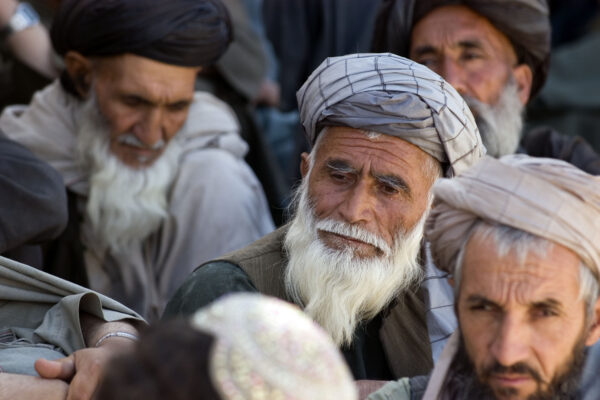
Tribal elders at a shura, a gathering where they decide about major issues. Photo: Ministry of Defence
All in all, Uruzgan is a highly problematic and high-risk province,’ Berlijn notes. He points to corrupt authorities, drug trafficking, a failing police force and terrain that is exceptionally well-suited for guerrilla warfare. Weighing everything up, the general arrives at a calculation: ‘With 1,100 Dutch troops, the ceiling of 1,000 troops assigned by you will be exceeded by approximately 100 troops. I deem this necessary for a responsible execution of the mission.’
The ceiling of a thousand men was devised by planners within the Defence Staff and adopted by Minister Kamp to anticipate political opposition. Within the Balkenende II cabinet, the D66 ministers Brinkhorst and Pechtold are hesitant; in the House, their parliamentary group threatens to back out. By placing the emphasis on ‘reconstruction’, the government hopes to win over the doubters. Terms like ‘fighting’ and ‘war’ are anxiously avoided. The fewer troops, the better, is the political reasoning. Retired General Pieter Cobelens, then head of the planners: “As a military officer, you cannot put your fingers in your ears and refuse to understand how politics works. If you do, you make misjudgements.” Kamp adopts the advice of Chief of Defence Berlijn.
‘On the brink of ‘state collapse’
Monday 9 August 2021, 06.51 Kabul, Netherlands embassy
In his weekly sitrep, Cees Roels summarises the situation: ‘The TB are advancing faster than expected, 215 (of the 419) districts are under TB control (…). The Dutch embassy cannot provide assistance with evacuations.’ Once again, there is no response from The Hague.
The Hague, Ministry of Defence
Yet the pleas for help seem to have hit home. During a briefing, the Special Operations Command (NLD SOCOM) proposes sending 10 to 12 commandos to Kabul immediately to test the evacuation plans. SOCOM reports directly to General Onno Eichelsheim, the Chief of Staff. However, his deputy, Lieutenant-General Boudewijn Boots, rejects the plan. The highest military command assesses that an evacuation can easily be carried out using regular scheduled flights and chartered planes. This position is not shared with the embassy in Kabul, where diplomat Roels remains in the dark a week after the car bomb.
Tuesday 10 August 2021 The Hague, Frederik Barracks
The MIVD (Military Intelligence and Security Service) reports that it is ‘unlikely’ that the Taliban will attempt to take Kabul by force within three to six months.
Wednesday 11 August 2021 The Hague, Ministry of Defence
The SOCOM commander repeats his proposal to deploy special forces. Once again, the military top leadership rejects it. The argument: deploying commandos and potentially evacuating personell would send the wrong signal. It could trigger panic among the Afghan authorities and other embassies, causing a snowball effect. There is no indication that the Ministry of Defence shared these operational considerations with Foreign Affairs. The ministers involved would later state they knew nothing about this. On that eleventh of August, the military leadership’s assessment appears entirely disconnected from the Afghan reality.
Thursday 12 August 2021 The Hague
The MIVD drastically revises its assessment: Kabul could fall within 90 days.
Kabul, Netherlands embassy
News arrives that the strategic city of Ghazni, located on the vital Kabul–Kandahar highway, has been captured. For Roels, all the alarm bells go off: ‘It’s like living in Amsterdam and The Hague is already under enemy control. From there, it’s only an hour’s drive to Kabul.’
That same day, Herat, the country’s third-largest city, also falls. Footage emerges on social media showing the government army retreating headlong. This is the day the British mobilise 600 troops to secure the evacuation of their diplomats and citizens. ‘They get help,’ Roels thinks. The military support he is pleading for fails to materialise.
Friday 13 August 2021, 06.30 Hilversum, NOS newsroom
The morning news reports that the primary former Dutch base, Camp Holland in Uruzgan, has fallen for good. The site is a symbol of years of dedication and the sacrifices of killed and wounded personnel. The caretaker foreign minister, Sigrid Kaag, responds with sympathy, but her compassion does not dispel the deep frustration felt by veterans. To them, this feels like the inevitable consequence of the political opportunism that ended an unfinished mission in 2010, leaving the Taliban as the laughing third party, operating on the mantra: ‘You have the watches, we have the time.’
The resentment reaches boiling point when veterans see social media footage of the religious zealots raising their white flag on the gates of Camp Holland. In the streets of the adjacent provincial capital, Tarin Kowt, they triumphantly empty the magazines of their Kalashnikovs into the air.
The Hague, Frederik Barracks
The MIVD sharpens its prediction from the previous day. If the advance continues at this pace, Kabul will be completely encircled by 31 August at the latest. Allied intelligence services back this analysis.
Kabul, Netherlands embassy, 18.38
According to Roels, reality is moving much faster. His messages to Foreign Affairs grow increasingly alarmed: ‘Afghanistan is on the brink (or has already gone over the brink) of a state collapse.’
The Hague
Speaking to an NOS camera, Minister Kaag states that she spoke with the embassy that morning about security: ‘In view of the high risks, I cannot say anything about it now. But we are working on this day and night, both from The Hague and in Kabul.’
Kabul
‘Working on what exactly?’ the diplomat on the ground wonders, as the Pentagon announces it is sending 3,000 additional troops to secure the closure of its embassy and the evacuation. Cees Roels’ requests for military assistance remain unanswered.
‘You don’t want to watch this crazy Taliban zombies entering the city, get out!’
Saturday 14 August 2021 Kabul, Netherlands embassy, 02.41
Cees Roels types a flash update. The near-continuous roar of low-flying helicopters moving allied embassy staff to the airport drowns out his typing: ‘The entire diplomatic community is running for the exit as we speak (we never leave, but we are now) everyone flying out within 48 hours,’ he reports to his ministry in The Hague: ‘We cannot sacrifice our staff – expatriate and local – to party-political compromise.’
During an emergency NATO meeting that afternoon, Roels receives a warning from a source who tells him that the Taliban are bolstering their forces by opening all prison doors. ‘He gave me a message: “You don’t want to watch this crazy Taliban zombies entering the city, get out!”’
Flash update Saturday 14 August, 02.41
Furthermore, Roels is confidentially informed that the US will completely withdraw to the airport within three days. He closes his overnight message prophetically: ‘Tomorrow I will provide an update that will not be pleasant.’
Soest, Netherlands, 14.15
Eric Schouten is at a riding stable celebrating his son’s eighth birthday. Schouten is the director of Dyami, a company that advises governments and businesses on geopolitical risks, and he spent 13 years working as a liaison officer for the AIVD (General Intelligence and Security Service). He pays no attention to the party; he is staring at his tablet, transfixed. ‘I can see a huge number of transport aircraft on Flightradar, especially from the US Air Force, flying in and out of Kabul,’ he explains to the guests.
Shortly afterwards, he receives a call from an initiative group looking to help stranded Dutch citizens in Kabul. Schouten knows what he has to do. He calls his operations manager, who is off sick at home. They arrange to meet at the office in Utrecht at eight o’clock the following morning.
Kabul, Netherlands embassy, 15.30
Cees Roels experiences the most difficult moment of his career. His local staff are terrified and at their wits’ end: ‘People who are so dependent and see that things are going wrong. It was a matter of life and death.’ The employees refuse to leave without the family members living with them. This involves around 60 people in total. They know what their fate will be if the Taliban find them.
However, the previous wednesday, the cabinet decided that, apart from immediate families, only three ‘hardship cases’ would be permitted to join. The embassy itself must choose which three individuals qualify. Roels consults with Ambassador Wijgers. On behalf of them both, she sends an email to senior officials in The Hague. ‘It seems inconsistent to leave these colleagues behind now, given that we, as expatriate staff, have relied on them daily for nearly 20 years, including during difficult times,’ the diplomatic plea concludes.
By the end of the afternoon, there is still no response. Roels watches his staff succumb to the paralysing uncertainty; some are suicidal. He addresses them and, visibly moved, makes the executive decision on his own authority: ‘Everyone is coming. That was my decision. I really didn’t care if someone in The Hague got very angry about it.’
Wilnis, Netherlands, 18.25
Derk Boswijk (CDA) is celebrating his mother’s birthday with a barbecue but has spent the last half hour in his parents’ first-floor bedroom. Aid organisations in Kabul are bombarding him with messages stating that the city is collapsing. Boswijk has been an MP for just five months and holds the defence portfolio. The previous Tuesday, he and the opposition submitted urgent written questions regarding the evacuation of the interpreters. He feels invested in their fate and believes that too little is being done.
The Hague, 18.35
During a ministerial conference call, the cabinet’s stance remains cautious: only the immediate family of local staff may come. The position of the State Secretary for Justice and Security, Ankie Broekers-Knol, is set in stone. Based on incoming emails, she is – as she would later claim – afraid that as many as 100,000 Afghans will head this way. In reality, the issue at that moment concerns 58 additional family members. At the urging of Minister Sigrid Kaag, the cabinet finally agrees to their arrival.
Kabul, Netherlands embassy, 21.20
At the embassy that evening, staff work through the night to draw up as many emergency travel documents – laissez-passers – as possible. That the city will fall is now certain. Because the pace of the advance has been consistently misjudged, the defence attaché requests The Hague to place military transport aircraft (C-130 and KDC-10) on standby before 18 August. Roels discusses the plan to move to the airport the following evening with his BSB (Brigade Special Security Tasks) team. But events take a different turn.
23.50
A US officer, the so-called battle captain, calls the Dutch BSB commander: ‘The Taliban are inside. Security for the diplomatic enclave has collapsed. The access roads are in their hands. Five thousand prisoners have been released. Get out, now!’
The BSB commander promises to travel to the airport the following morning. ‘Sir, are you awake?’ the American asks, dumbfounded. They must drive now, otherwise the US forces can no longer guarantee their safety.
The commander wakes Roels, who has only just gone to bed. In accordance with protocol, the staff destroy all documents and data carriers. They disconnect the server and disable it. The travel documents for the local staff are left behind at an agreed, secure location. Roels calls the crisis coordinator in The Hague. There is no longer any time for discussion: ‘Listen, this is the situation, we have to leave now and will continue at the airport.’
Sunday 15 August 2021, 01.00
The convoy sets off. The armoured SUVs speed through the deserted streets; all official police checkpoints are unmanned. The BSB operators navigate their route through the ghost city. Everyone must turn off their mobile phones; external contact is prohibited. Ten minutes later, they reach the airport. Once there, it takes fifteen minutes for the gate to open. The area is crowded with fleeing diplomats.
Saturday 14 August 2021 Goor, Netherlands, 22.42 (Dutch time)
That evening, Defence Minister Ank Bijleveld leaves the turmoil in The Hague and the crisis in Kabul behind for a moment. She tweets: ‘Tonight I watched the film “The Forgotten Battle”. A “forgotten” operation, but the largest on Dutch soil, with tens of thousands of casualties. It makes you aware of the price paid for our freedom.’
‘But how many people did we actually go to Uruzgan with?’
Friday 6 October 2006 Uruzgan, Tarin Kowt, Camp Holland
In the centuries-old Afghan tribal culture, the law of the jungle prevails. In Uruzgan, that power belongs to Matiullah Khan, the leader of the Popalzai tribe. He commands a heavily armed militia of 2,000 men. Local sources describe him to a Foreign Affairs investigator as a wolf in sheep’s clothing, who imprisons and tortures opponents.
Khan is the self-appointed boss of the officially disbanded Afghan Highway Police. He has single-handedly revived the AHP, and it is a lucrative business. The road from the airport in Kandahar to Tarin Kowt is the primary supply route for Camp Holland. Due to a chronic shortage of troops, the Dutch cannot protect this vital lifeline themselves. It is a task Khan and his men are glad to take on. Formeel, the Netherlands does not do business with him, but a report from March 2008 reveals that Dutch military personnel are even training his militia members in return.
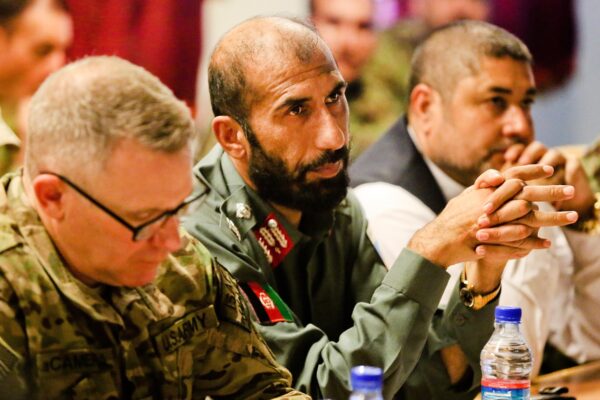
In the middle, Matiullah Khan. Photo: U.S. Department of Defence
Matiullah Khan collects $1,500 to $3,000 per lorry for his protection. If payment is not made on time, the protection is withdrawn, and the convoys are attacked or struck by roadside bombs.
‘Naturally, it was suggested that the Taliban carried out those attacks, but it could very well be that Matiullah organised them himself,’ says Lieutenant General Ton van Loon, the ISAF commander in southern Afghanistan at the time. ‘There was an alternative. But how many people did we actually go to Uruzgan with? If you had wanted to protect that entire road yourself, it would have cost a great deal of manpower and a lot of blood.’
Warlord Khan solves the Dutch personnel shortage. He earns $4 million to $7 million a year from the NATO mission. It will not be the only time that the shortage of troops manifests itself painfully.
‘We need to get out of here, but I’m afraid to go outside’
Sunday 15 August 2021 Hamid Karzai International Airport, 06.30
The embassy team sets up a makeshift office in the military section of the airport. They inform their contact person in the city of their departure and share the instructions that will allow the local staff to access the documents left behind. Overall security at the airport is in the hands of the United States.
Kabul, Shahr-e-Naw district, 08.00
Mirwais is in the city with his wife and two children for a flying visit to his sick mother-in-law. He fled the Taliban in his twenties and holds a managerial position in the Netherlands. Yesterday, the family were still walking through a lively city centre. Now, his 17-year-old daughter watches from the eleventh floor as all the shop shutters are closed. Below, the Taliban celebrate their victory in pickup trucks with celebratory gunfire and set up checkpoints. His daughter cries: ‘We need to get out of here, but I’m afraid to go outside.’ Mirwais emails Foreign Affairs. The response: keep an eye on your inbox 24/7.
Hamid Karzai International Airport, 08.30
The embassy team’s quarters are located 30 metres from the perimeter wall. The staff can see the Taliban flags rising above it. Gunfire is heard; the situation is chaotic. The BSB commander orders everyone to stay inside and stick together.
08.45
Medical student Musafir Nader arrives at the airport, assuming he can catch his flight home. But during check-in, all flights are cancelled. Security guards flee as civilians rush onto the airport in huge numbers. Musafir hears that the Taliban are already claiming the city and calls his family to pick him up. He emails Foreign Affairs but receives no reply.
Kabul, Netherlands embassy, 10.00
The local staff arrive at the abandoned building. They are angry and disappointed that the personnel have left without them. The manager maintaining contact explains the situation and shares the good news that the cabinet has extended the evacuation scheme to include extended family. For their own safety, he then sends everyone home, where they must await further updates.
Utrecht, 07.30 (Dutch time)
At Dyami, Eric Schouten and his operations manager, Annick Dingemans, watch the chaos in the group chat escalate. Desperate Afghan-Dutch citizens are unable to reach The Hague. Dingemans contacts them directly to provide moral support, while Schouten builds a network of contacts in Kabul. This includes local people driving around the city to map out safe routes. They monitor the Taliban checkpoints by the hour: are they aggressive, are they checking passports? CDA MP Derk Boswijk has since joined the group chat. He forwards pleas for help from stranded citizens to Foreign Affairs but sees that they remain unanswered.
Kabul, presidential palace, 14.00
The national security adviser urges President Ashraf Ghani to flee the country.
14.45
Three transport helicopters depart heading east, but veer northwards and set course for Uzbekistan.
Hamid Karzai International Airport, 15.15
The alarm wails due to incoming rockets. The Dutch embassy team shelters in the bunker for two and a half hours while US Apache helicopters repel ground attacks.
Termez, Uzbekistan, 16.00
President Ghani and his entourage land without permission due to a lack of fuel. They are held at gunpoint by Uzbek border guards until their identities are verified. That evening, President Ghani and his party charter a private plane to Abu Dhabi for $120,000, where President Sheikh Khalifa bin Zayed Al Nahyan grants them asylum on humanitarian grounds.
The Hague, from 18.00
While Kabul falls and her embassy team is under fire, Minister Sigrid Kaag (D66) hosts a private dinner at her home for her second-in-command, Rob Jetten, Lilian Ploumen (PvdA) and Jesse Klaver (GroenLinks). The food is delivered by a caterer. The cabinet formation is proving difficult, so they ‘just wanted to catch up’, the participants state afterwards.
Hamid Karzai International Airport, 21.15
The crew of a US transport aircraft close the cargo ramp as desperate Afghans climb inside. A Boeing C-17 normally accommodates 134 troops. After landing in Qatar, the commander counts 640 refugees leaving the cargo hold of flight Reach 871.
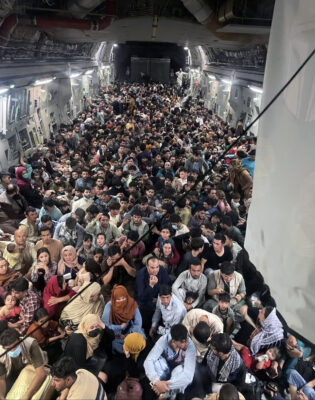
Flight Reach 871 Photo: U.S. Department of Defence.23.30
Cees Roels and his people try to get some sleep on the floor and benches of the small office building. Due to the adrenaline, very little comes of it.
‘The cabinet stands behind this decision’
Monday 16 August 2021 Utrecht, Netherlands, 08.30
Empty pizza boxes reveal that Eric Schouten and his team have pulled an all-night shift. They are now in contact with dozens of stranded Dutch citizens, whom they are trying to guide as safely as possible to the airport via their informal network.
The Hague, 09.00
During a crisis meeting at Foreign Affairs, senior officials express their desire for Roels’ team to remain until a new team arrives: a ‘warm handover’. The BSB leadership present immediately rejects this request from The Hague; given the extreme lack of safety, it is simply not realistic.
Hamid Karzai International Airport, 09.30
From their makeshift office, the embassy team can do less and less. Internet and telephone connections are failing. Overnight, the BSB reconnoitred the airport and devised a plan to guide the local staff and interpreters inside, but establishing contact proves impossible. Meanwhile, a shadow embassy has been set up in The Hague, led by Ambassador Caecilia Wijgers. At the same time, the Americans close the airport to civil aviation. Everything must now be handled by military aircraft. Due to the chaos on the runways, a Dutch C-17 evacuation flight is denied permission to land by the US military.
10.00
The Afghan border police have left. The security perimeter on the civilian side of the airport no longer exists. US troops are guarding only the military section. They gamble that the fences around the civilian terminal will provide enough protection for the runways. A miscalculation. Thousands of desperate Afghans flood the grounds, scaling walls with ladders and cutting through the barbed wire; fences give way.
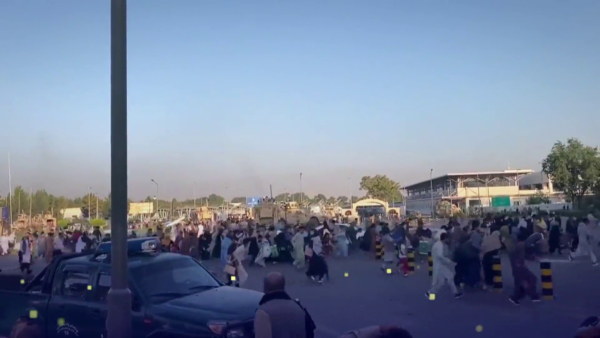 Desperate Afghans overrun Hamid Karzai International Airport. Still from video
11.30
A US C-17 Globemaster taxis at walking pace across the apron. Hundreds of Afghans run alongside the aircraft. Some cling to the wings and wheel wells. Just ahead of the aircraft’s nose, two Apache helicopters make low strafing runs to clear the runway.
11.42
The captain applies full throttle and takes off. The desperate attempts of those who refuse to let go end on the tarmac of the runway, or moments later on the snow-capped peaks of the Hindu Kush mountains. Anyone who sees these images will have them seared into their memory forever.
Saint-Tropez, France, 10.03
Tijs, a member of the Korps Commandotroepen (KCT) [Special Forces Regiment], is on the beach with his family. His mobile phone rings. In The Hague, it has just been decided that Roels and his team in Kabul will be relieved by Ambassador Wijgers and a unit of special forces led by Major Tijs. He must report to the KCT barracks as soon as possible. Half an hour later, his family is in the camper van in a state of shock, and he is behind the wheel. On the way to Roosendaal, the commando puts his foot down. They only stop for food; toilet stops are avoided by using plastic bags.
Hamid Karzai International Airport, 18.16
The fear is that, alongside civilians, terrorists from ISKP (Islamic State Khorasan Province), an affiliate of Islamic State, have also infiltrated the airport. The embassy team takes shelter in the bunker once again. The Americans demand that they leave. The reason: they have no military protection of their own.
Roels texts the crisis coordinator in The Hague: ‘US calling for immediate departure (…) The number of breaches is now increasing, with large groups walking onto the airfield. US cannot guarantee we can fly out after tonight.’
Roels and his BSB commander agree that leaving is the only option. Since weapons are prohibited on board the US flight, the BSB operators disable their own equipment. It must not fall into the hands of the Taliban.
18.30
Prime Minister Rutte, Minister Kaag and Minister Bijleveld have consulted: the team must remain to ensure a ‘diplomatic presence’ and a ‘warm’ handover.
For Roels, the instruction comes as a complete surprise. He leaves a meeting with coalition partners. He calls a senior official in The Hague and explains that they can do nothing, and without weapons or reinforcements, they are sitting ducks.
19.00
Sigrid Kaag calls and asks if anyone can stay behind in Kabul. Roels refuses: ‘Who in The Hague takes responsibility if things go wrong?’ Kaag evades the question.
After the conversation, Roels takes stock: the Americans demand that the Netherlands independently guard an access gate to bring their compatriots inside, but that military capacity is lacking. Communications are down. His consular staff have looked death in the eye; the BSB operators’ weapons have already been destroyed. As far as the diplomat is concerned, there is no turning back: the entire team is leaving tonight. A month later, Kaag would state in parliament: ‘I was informed by the chargé d’affaires ad interim and I wished him a good flight. He therefore also departs with the political support of the responsible minister. (…) The cabinet stands behind this decision.’
20.02
The embassy team boards a US C-17. Due to the chaos around the runways, the aircraft does not take off until six hours later. Airborne, Roels thinks of the men and women of his local staff who are waiting in vain for news in the city. He is left with a bitter aftertaste because, despite his promise, he was unable to save them. He curses the absence of the military reinforcements he had begged for. What he does not know yet is that the Defence Staff had twice proposed sending special forces, but the country’s second-highest military officer had resolutely rejected it. (To be continued)
Part 2 of ‘The Fall of Kabul’ appeared on Tuesday 25 August, both online and in the September issue of HP/De Tijd. I will translate it soon.
Bart Nijpels
- Cees Roels, interview, 17 February 2022.
- Musafir Nader, interview, 5 February 2022.
- Wahid, interview, 5 February 2022 (name changed for security reasons).
- Mirwais, interview, 5 February 2022 (name changed for security reasons).
- Major Tijs (first name only, due to the classified nature of his work).
- Pieter Cobelens, interview, 19 January 2022.
- Eric Schouten, interview, 28 January 2022.
- Annick Dingemans, interview, 28 January 2022.
- Derk Boswijk, interview, 17 February 2022.
- Ton van Loon, interview, 19 January 2022.
- Mart de Kruif, various conversations and interviews.
-
- Thousands of declassified government documents, including email correspondence between the embassy in Kabul and the Ministry of Foreign Affairs.
- Media reports from NRC, De Volkskrant, NOS Nieuws, AD, Reporter, and KRO-NCRV.
-
- ‘De evacuatie uit Afghanistan. Crisisplan’ (The evacuation from Afghanistan. Crisis plan), 12 December 2021.
- ‘Reconstructie en analyse van de evacuatie uit Kaboel in augustus 2021’ (Reconstruction and analysis of the evacuation from Kabul in August 2021), committee chaired by Maarten Ruys, 6 October 2023.
- ‘Deadly Embrace. The decision paths to Uruzgan and Helmand’, Mirjam Grandia Mantas, 2 April 2015.
- ‘Feitenrelaas Evacuatie Afghanistan’ (Factual account of the Afghanistan evacuation), 7 September 2021.
- ‘Warlord, Inc. Extortion and corruption along the US supply chain in Afghanistan’, report for the US Congress, John F Tierney, June 2010, p 25.
- ‘Special Inspector General for Afghanistan Reconstruction’, Report 22-35-IP.